
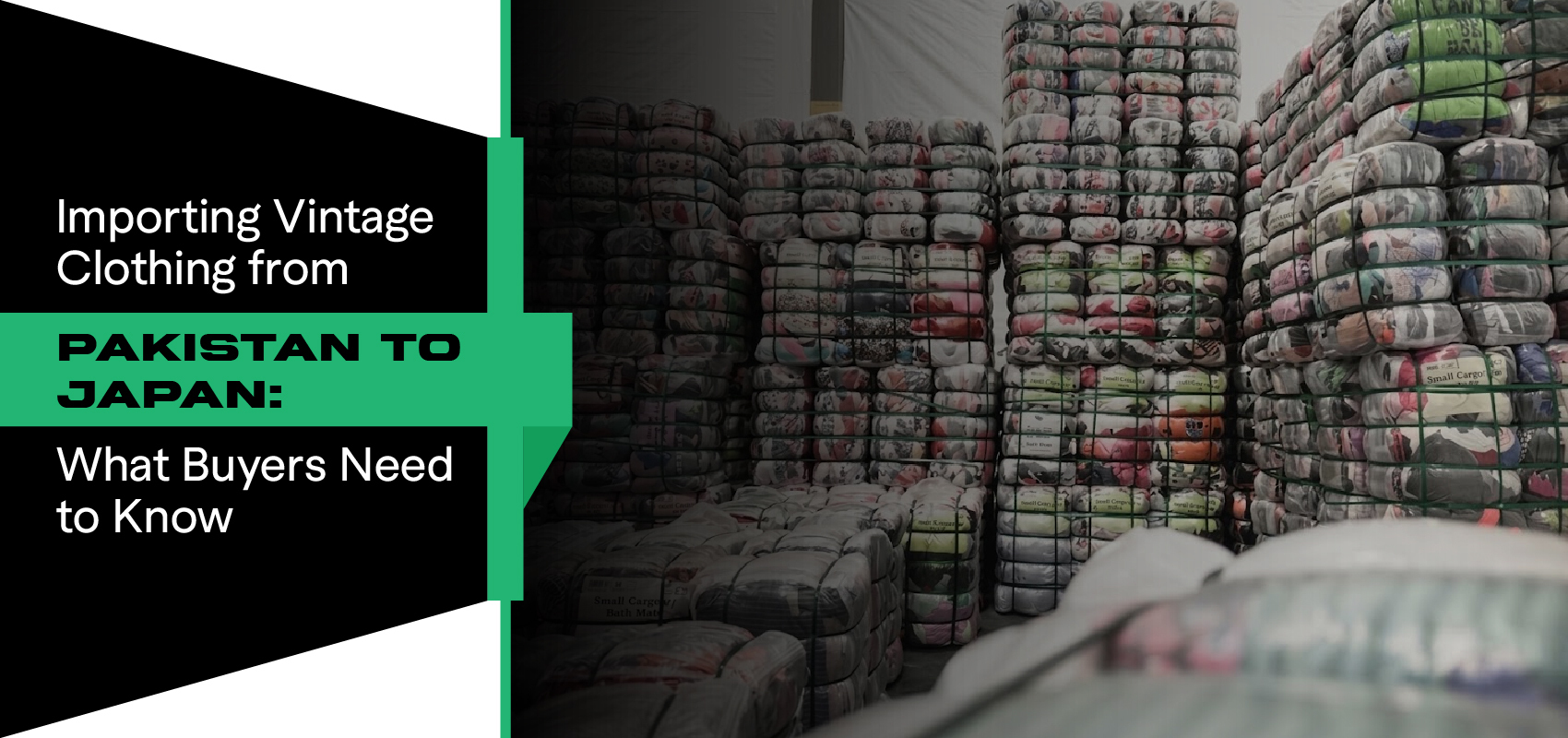
Japan is one of the most consistent destination markets for vintage clothing imports from South Asia. Pakistani exporters supply bulk vintage clothing to Japanese wholesale buyers across multiple categories, and the Japan-Pakistan vintage clothing trade represents a well-established commercial route that has operated for many years. For Japanese buyers considering their first import from Pakistan, or for existing importers reviewing their process, understanding how the supply chain works — from selection and grading through to documentation and customs clearance — is essential to running a smooth and profitable operation. This guide covers the key things Japanese vintage clothing importers need to know when sourcing from Pakistan.
Why Japanese Buyers Source Vintage Clothing from Pakistan
Pakistan has one of the largest and most developed second-hand textile processing industries in the world. Karachi is a significant hub for the sorting, grading, baling, and export of used and vintage clothing to destinations across Asia, Europe, Africa, and beyond.
For Japanese wholesale buyers, Pakistan offers specific practical advantages that are worth understanding clearly.
Volume capacity. Pakistani exporters can supply consistent container-level quantities on a reliable basis. For Japanese importers who need predictable, recurring stock replenishment, this consistency is an important operational factor that small-scale domestic suppliers or regional intermediaries cannot match.
Established grading infrastructure. Pakistan’s used clothing industry has developed structured sorting and grading processes over decades of international export experience. Buyers who communicate their requirements clearly can expect those standards to be applied consistently, particularly when working with exporters who have experience supplying the Japanese market specifically.
Direct export access. Sourcing directly from a Pakistan-based exporter eliminates the domestic intermediary margin that buyers pay when purchasing from regional wholesalers in Japan or other Asian markets. At container scale, this cost advantage is commercially significant.
Category flexibility. Pakistani exporters supply a broad range of vintage clothing categories — mix vintage, original branded vintage clothing, Y2K vintage, and seasonal selections. Japanese buyers can specify composition based on their own market requirements rather than accepting a fixed offering.
How to Evaluate a Pakistani Vintage Clothing Exporter
For Japanese buyers who haven’t worked with a Pakistani exporter before, supplier evaluation is the most important step before any order is placed.
Ask about Japan-specific experience. Not all exporters are familiar with the specific quality expectations of the Japanese market. Exporters who have supplied Japanese buyers before understand that condition standards, era expectations, and communication requirements differ meaningfully from those of buyers in other markets. Ask directly whether they have existing Japanese buyers and what they understand about those specific requirements.
Request grading criteria in writing. Japanese buyers typically require higher condition standards than most other wholesale markets. Ask the exporter to describe exactly what their Grade A means in practice — not just the label, but the specific condition criteria applied at sorting stage. An exporter who can answer this specifically is demonstrating the kind of process awareness that produces consistent shipments.
Request pre-shipment photos or video. Before any container ships, request photos or a video walkthrough of bale contents. This is standard practice for established international wholesale relationships, and any experienced exporter will provide this without hesitation. For Japanese buyers in particular, visual verification before loading is a practical way to confirm that condition and era composition match what was agreed.
Start with a trial container. Japanese buyers typically begin supplier relationships with a smaller trial order before committing to regular full-container volume. This is a well-understood approach in the Pakistan-Japan vintage clothing trade. A trial container allows buyers to verify condition consistency, communication quality, and documentation completeness before scaling.
What Japanese Vintage Clothing Buyers Typically Look For
Understanding what Japanese buyers require — and making sure the exporter understands this before packing — is the most effective way to avoid yield problems after arrival.
Condition is non-negotiable. The Japanese second-hand retail environment operates on condition standards that are higher than most wholesale markets globally. Garments with significant staining, broken closures, excessive wear, or structural damage that would be considered resaleable in other markets are typically rejected by Japanese buyers or priced down sharply on arrival. Only export-grade condition should be included in shipments to Japan, and the exporter should understand this clearly before sorting begins.
Era accuracy matters more in Japan than in most markets. Japanese vintage buyers have deep era knowledge and look specifically for garments from defined periods — primarily American and European vintage from the 1960s through to the early 1990s. Mix vintage for Japan should reflect genuine era coverage rather than generic recent second-hand clothing. Pieces from the 2010s and later do not meet Japanese vintage buyer expectations unless they fall into a specific and clearly defined aesthetic category.
Brand presence adds significant value. Recognisable label pieces from established American and European brands command strong premiums in the Japanese market. Where branded pieces are available within a vintage shipment, they improve overall yield and buyer satisfaction considerably. The Japanese market’s familiarity with brand authentication means labels on these pieces should be genuine and clearly intact.
Consistency across shipments is weighted heavily. Japanese buying culture places significant value on long-term supplier reliability. A first container that meets expectations creates the foundation for an ongoing relationship. A first container that underdelivers on condition or composition rarely leads to a second order. Exporters who understand this tend to invest more care in Japan-bound shipments than in those for less demanding markets.
Import Documentation Requirements for Japan
Japanese customs requirements for used clothing imports are specific and must be satisfied completely to avoid delays at port.
Commercial invoice. The invoice should accurately describe the goods — “used mixed vintage clothing bales” or similar — with correct quantity, weight, declared value, applicable HS code, and complete exporter and importer details. Vague or generic descriptions can invite additional customs scrutiny.
Packing list. A detailed packing list matching the commercial invoice should list every bale by weight and content description. Japanese customs officers cross-reference the packing list against the shipment carefully, and any significant discrepancy can trigger an inspection or hold.
Bill of lading. Required to take possession of the goods at the destination port. Japanese importers should confirm the document format — original bill of lading by courier or electronic release (telex release / seaway bill) — with their freight forwarder well before the vessel departs.
Certificate of origin. Confirming Pakistan as the origin country. This may affect applicable duty rates depending on the trade framework between Japan and Pakistan at the time of import. Confirm with a Japanese customs broker whether a certificate of origin has practical tariff implications for your specific shipment.
Fumigation certificate. Required for used clothing imports into Japan. A valid fumigation certificate from a certified provider must accompany every shipment. Missing or invalid fumigation documentation is one of the most consistent causes of port delays on Japan-bound vintage clothing containers. Confirm fumigation is completed and documented before the vessel departs.
Japanese customs clearance. Japanese importers typically work with a licensed customs broker (通関業者) who files the import declaration and manages port clearance. Providing all required documents to the broker in advance of the vessel’s arrival is essential to avoiding port storage charges that begin accumulating from the vessel’s berthing date.
Shipping from Pakistan to Japan: Key Points
Transit times. Sea freight from Karachi to major Japanese ports — Yokohama, Osaka, Kobe, Nagoya — typically takes 18 to 25 days depending on the shipping line, routing, and port. Buyers should factor this into restocking timelines alongside the sorting and export preparation time at the exporter’s end.
Total lead time. From order confirmation to container arrival at a Japanese port, buyers should typically allow 35 to 45 days — covering sorting and baling time, export documentation preparation, container booking, and sea transit. Planning orders well ahead of when stock is needed avoids restocking gaps.
Container options. Most vintage clothing importers in Japan use 20ft containers for first shipments and move to 40ft containers as volume requirements grow. Container loads are typically calculated by weight (kg) and bale count. Buyers should confirm expected total weight and bale count with the exporter before booking freight to ensure the container specification matches the order volume.
Freight forwarder coordination. Japanese importers work either with a Japan-side freight forwarder who coordinates with Pakistan-side logistics, or directly with a Pakistan-based export agent who manages the full export leg. Either arrangement works. What matters is that document delivery timelines are agreed and met before the vessel arrives at port.
Building a Long-Term Supplier Relationship from Japan
Japanese wholesale buying culture weights long-term supplier relationships heavily over transactional purchasing. Understanding this from both sides shapes how the Pakistan-Japan vintage clothing relationship tends to develop.
Communicate specifically. Japanese buyers who articulate clearly what they need — condition standards, era requirements, composition preferences, documentation timelines — give exporters the specific information needed to deliver well. Vague orders produce vague results. Requirements agreed in writing before each order is confirmed set both parties up for consistent outcomes.
Provide feedback after each shipment. Letting an exporter know which pieces met expectations and which didn’t is information that improves subsequent shipments. Exporters who receive specific feedback can adjust their sorting and baling for the next container. Those who receive no feedback have less to work with.
Scale gradually. Starting with a trial order, confirming that the first shipment meets expectations, then placing a larger order for the second is the standard relationship-building model for this trade route. It protects the buyer while giving the exporter the opportunity to demonstrate consistency. Most established vintage clothing suppliers for Japan are familiar with this approach and will accommodate it without hesitation.
FAQs
Is vintage clothing from Pakistan of suitable quality for the Japanese market?
Yes, when sourced from an exporter who understands Japan-specific requirements. Pakistan’s used clothing industry has developed a well-structured grading infrastructure, and exporters with Japanese market experience apply the higher condition standards that Japanese buyers expect. The key is working with an exporter who sorts specifically to Japanese-grade standards rather than applying general wholesale grading and expecting the buyer to accept whatever grade is used for other markets.
What HS code applies to used clothing imports into Japan?
Used clothing is generally classified under HS 6309.00 in Japan, covering worn clothing and other worn textile articles. Buyers should confirm the exact applicable code with their Japanese customs broker, as classification details may vary depending on the specific goods and presentation. The HS code affects the applicable duty rate and should be confirmed before the first shipment.
How long does sea freight from Pakistan to Japan take?
Sea freight from Karachi to major Japanese ports typically takes 18 to 25 days. Including sorting, packing, and export documentation time at the exporter’s end, buyers should allow approximately 35 to 45 days from order confirmation to container arrival at the Japanese destination port.
Is a fumigation certificate required for used clothing imports from Pakistan to Japan?
Yes. Fumigation certification is required for used textile imports into Japan. Any experienced exporter supplying Japanese buyers provides this as a standard part of every shipment’s documentation. Buyers should confirm that fumigation is completed before the vessel departs and that the certificate references the correct container and seal numbers. Missing fumigation documentation is one of the most common and avoidable causes of customs delays.
Can I specify which vintage categories I want in my Japan-bound container?
Yes. Experienced exporters accommodate category preferences — mix vintage, branded vintage, specific era focus, or condition-specific selections — when the order is confirmed. Discussing your composition requirements in detail before packing begins ensures the bale contents align with your market expectations. Requesting pre-shipment photos or video allows you to verify composition before loading, which is strongly recommended for first-time orders.
Conclusion
Importing vintage clothing from Pakistan to Japan is a well-established trade route with a clear and manageable process once buyers understand what it requires. The exporters who serve Japanese buyers well are those who understand the market’s specific condition standards, communicate transparently, and deliver complete and accurate documentation on time. Japanese buyers who invest in finding the right exporter relationship — beginning with careful evaluation, a trial order, and clear communication about what they need — build supply arrangements that deliver consistent, reliable stock across the long term.