
If you run a vintage store, sell on Depop or Vinted, trade at markets, or run kilo events, buying vintage clothing wholesale in the UK is one of the most effective ways to scale your stock without paying retail prices for every piece. But the wholesale market can feel confusing when you’re first getting into it — different categories, different grades, prices that seem inconsistent, and suppliers ranging from reliable long-term partners to one-off operations with no traceability.
This guide cuts through the noise. It explains what vintage clothing wholesale actually means for UK buyers, what categories are available, where the stock comes from, how pricing works, and what to get right before placing your first bulk order.
What Does Wholesale Vintage Clothing Actually Mean?
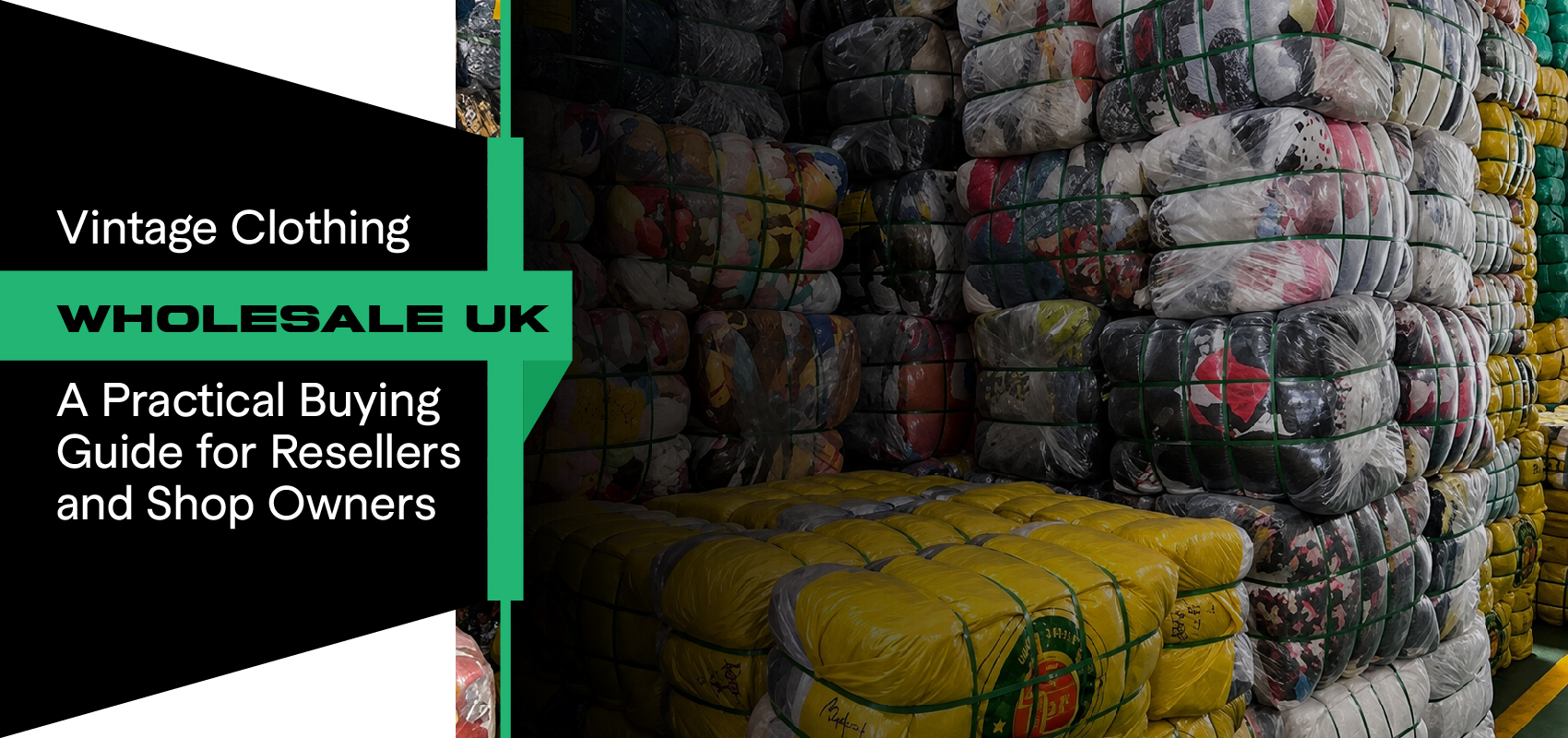
Wholesale vintage clothing means buying second-hand garments in large quantities — typically by the kilogram or by the bale — directly from a supplier or exporter rather than sourcing individual pieces. Instead of hunting through charity shops or bidding at auctions, you receive large compressed bales of sorted garments, ready to list, hang on a rail, or sell at a kilo event.
For UK resellers, this is the foundation of how serious vintage businesses are built. The economics work because buying in volume at the right price per kilogram creates enough margin to list and sell pieces individually at a profit — whether through a physical store, an active online presence, or regular market trading.
It’s worth saying clearly: this is not a complicated process once you understand it. The buyers who find it overwhelming are usually trying to navigate it without a clear picture of what the market actually looks like.
Who Buys Wholesale Vintage Clothing in the UK?
A wider range of people than most buyers expect.
Independent vintage store owners across London, Manchester, Bristol, Leeds, and Edinburgh are the most visible, but they’re far from the only ones. Active Depop and Vinted sellers who list dozens of items weekly, market traders who pitch at weekend vintage fairs, kilo event operators who need hundreds of kilograms per event, and eBay sellers who specialise in specific eras or categories — all sourced through wholesale channels.
What they share is that buying retail to resell isn’t financially viable at the scale their business needs. Wholesale is how they access the volume that makes the numbers work.
What Categories of Vintage Clothing Are Available Wholesale?
This is where the UK market is more sophisticated than many buyers initially realise. There are distinct product categories with different buyer profiles, pricing logic, and use cases.
Mix vintage is the starting point for most wholesale buyers. These are bulk bales of second-hand garments across multiple types — tops, trousers, jackets, knitwear, dresses — sorted by condition rather than any specific style or era. Mix vintage suits buyers who need broad variety and high volume. It’s the backbone of kilo events, high-turnover market stalls, and most online resale operations. RK Exports supplies mix vintage clothing wholesale to UK and European buyers directly from Pakistan, with options for summer vintage, winter vintage, or a combined seasonal mix.
Original branded vintage is a step up in curation. These bales are specifically sorted to include a high proportion of garments from recognisable international labels — Nike, Adidas, Levi’s, Carhartt, Champion, Patagonia, The North Face. For vintage store owners and online resellers whose customers are looking for specific labels, original branded vintage clothing is where the strongest per-piece margins come from.
Y2K vintage has become its own defined category in the UK market. Bales curated for late-1990s and early-2000s aesthetic — low-rise denim, velour tracksuits, baby tees, cargo trousers — appeal strongly to sellers supplying Depop buyers, younger vintage shoppers, and kilo events where Y2K pieces consistently attract social media attention.
Seasonal vintage refers to bales sorted specifically for either summer or winter garments. Buyers who plan their buying calendar around the UK resale season — ordering summer vintage in January to March and winter vintage in June to August — get their stock at the right time to sell, rather than warehousing out-of-season goods while their capital sits idle.
Where Does Wholesale Vintage Clothing Come From?
Most vintage clothing wholesale sold in the UK originates from overseas export operations. Understanding this supply chain helps buyers make better decisions about who they source from and why.
The global second-hand clothing supply chain starts with textile collection — donations, clothing banks, thrift store overstock — which is aggregated by sorting companies and exporters in countries with large textile processing infrastructure. Pakistan, in particular, has a well-established second-hand textile sorting and grading industry. Pakistani exporters supply bulk vintage clothing to buyers across the UK, Europe, Japan, Africa, and other markets — often at significantly better per-kilogram prices than domestic UK suppliers, because buyers accessing them directly are removing the domestic intermediary.
For a UK buyer, sourcing directly from a Pakistan-based exporter means better pricing per kilogram, more flexibility in how stock is sorted and prepared, and the ability to specify exactly what you need — branded vintage, mix vintage, seasonal selections, or Y2K-curated bales — rather than accepting what a domestic wholesaler happens to have available.
How Is Wholesale Vintage Clothing Priced?
Pricing in the wholesale vintage market is driven by two things: grade and category.
Grade refers to garment condition. Grade A stock — clean, no significant damage, ready for direct resale — is priced higher per kilogram than mixed-grade or lower-condition stock. The higher per-kilogram cost is usually justified by better yield: more pieces per kilogram that actually sell without additional sorting or processing.
Category drives pricing because different types of vintage carry different resale potential. A bale of curated Y2K pieces or original branded garments commands a higher per-kilogram price than general mix vintage, because the curation work has already happened at the supplier’s end and the per-piece resale margin is higher.
Beyond grade and category, a couple of other variables matter:
Volume. Container-level orders — 20ft or 40ft containers shipped direct from an exporter — typically produce significantly better per-kilogram pricing than smaller pallet or individual bale purchases, because logistics costs spread across a much larger quantity.
Origin. UK domestic wholesale suppliers charge more per kilogram than direct exporters, because they’ve added their own processing and logistics margin. For buyers with storage capacity and enough buying power to place a container order, going direct almost always produces better economics over time.
Mix Vintage or Branded Vintage: Which Works for Your Business?
This is the most common question UK wholesale buyers ask when looking to scale, and the answer depends entirely on who your customers are.
Mixing vintage clothing makes sense if your business runs on volume — kilo events, high-turnover market stalls, online accounts where you list dozens of items weekly at accessible price points. The per-kilogram cost is lower, the quantity is higher, and the variety suits buyers who need constant stock rotation.
Original branded vintage makes sense if your margin comes from per-piece value — a curated boutique, an online presence where customers pay specifically for the label, or a business that sells into European markets where branded vintage carries clear premiums.
Many established UK buyers run both in parallel. Mix vintage as core volume stock, branded vintage as the high-margin anchor. Starting with one and layering in the other as you understand your sell-through patterns is usually the sensible approach.
What to Think About Before Placing a Wholesale Order
Whether you’re placing your first order or reviewing your current supplier setup, a few things are worth getting clear before you commit.
What do your customers actually buy? This sounds obvious but it’s where a lot of buyers go wrong. Ordering 200kg of branded vintage when your customers are price-sensitive kilo shoppers, or ordering general mix when your Depop following specifically wants Y2K, creates a yield problem that’s expensive to fix after the goods arrive. Start with what you know sells.
How much can you realistically store and sort? A 20ft container holds roughly 20,000kg of compressed bales. That’s a large quantity to work through. Buyers who underestimate sorting and sell-through time often find their cash is locked up in stock longer than expected, which creates cash flow pressure.
Have you verified the supplier’s grading? Every supplier claims Grade A. What that means in practice varies significantly. Asking for pre-shipment photos or video of open bales before the container ships is the most reliable way to verify quality before committing. Any supplier confident in their standards will provide this.
Is your import documentation sorted? Container-level importing requires commercial invoices, packing lists, bills of lading, fumigation certificates, and UK customs clearance. First-time importers should have a freight forwarder in place before the goods ship. It’s not complicated once you’ve done it once, but it needs planning.
FAQs
What is the minimum order for vintage clothing wholesale in the UK?
This varies by supplier type. UK domestic wholesalers often sell in individual bales of 45–100kg without a container minimum. Direct exporters from Pakistan typically supply at container level (20ft or 40ft), which offers significantly better per-kilogram pricing for buyers who have storage capacity and consistent volume needs. If you’re importing for the first time, some exporters will discuss smaller consolidated options to let buyers verify quality before scaling to full container orders.
How do I know if wholesale vintage stock is genuinely Grade A?
Ask for pre-shipment photos or video of open bales before the goods ship. Grade A should mean clean garments free from significant staining, structural damage, or broken closures. Start with a smaller test order before committing to full container volume. Any supplier who is confident in their grading will accommodate this without hesitation.
Is it cheaper to buy vintage clothing wholesale from a UK supplier or import directly?
Direct importing from Pakistan-based exporters typically produces better per-kilogram pricing than buying through UK domestic wholesalers, because you’re removing the intermediary margin. The trade-off is managing freight, documentation, and customs clearance — which adds a small amount of administrative complexity. For buyers moving enough volume to justify a container order, the per-kilogram savings consistently outweigh this additional effort.
What is the difference between mix vintage and branded vintage wholesale for UK buyers?
Mix vintage is bulk second-hand garments across multiple styles and eras, sorted primarily by condition without a brand guarantee. Branded vintage is specifically sorted to include a high proportion of garments from recognisable labels — Nike, Levi’s, Carhartt, and similar brands — where label identity drives resale value. Mix vintage suits high-volume, price-driven resale channels; branded vintage suits buyers whose customers pay specifically for the label.
Can I choose what goes into my wholesale vintage order?
Yes, to a degree. Experienced exporters can accommodate seasonal sorting preferences, category weighting (more outerwear, more denim), and era-specific selections like Y2K. Exact bale composition can’t always be guaranteed with second-hand sourcing, but a good exporter works around your specifications. Discussing your requirements clearly before the order is confirmed always produces better results than taking a standard allocation.
Conclusion
Vintage clothing wholesale in the UK is less complicated than it seems once you have a clear picture of what the market offers and what your own business actually needs. The buyers who do it well aren’t doing anything mysterious — they know what their customers buy, they source from suppliers who deliver consistently, and they plan their buying calendar so stock arrives at the right time. Get those three things right and everything else follows.