
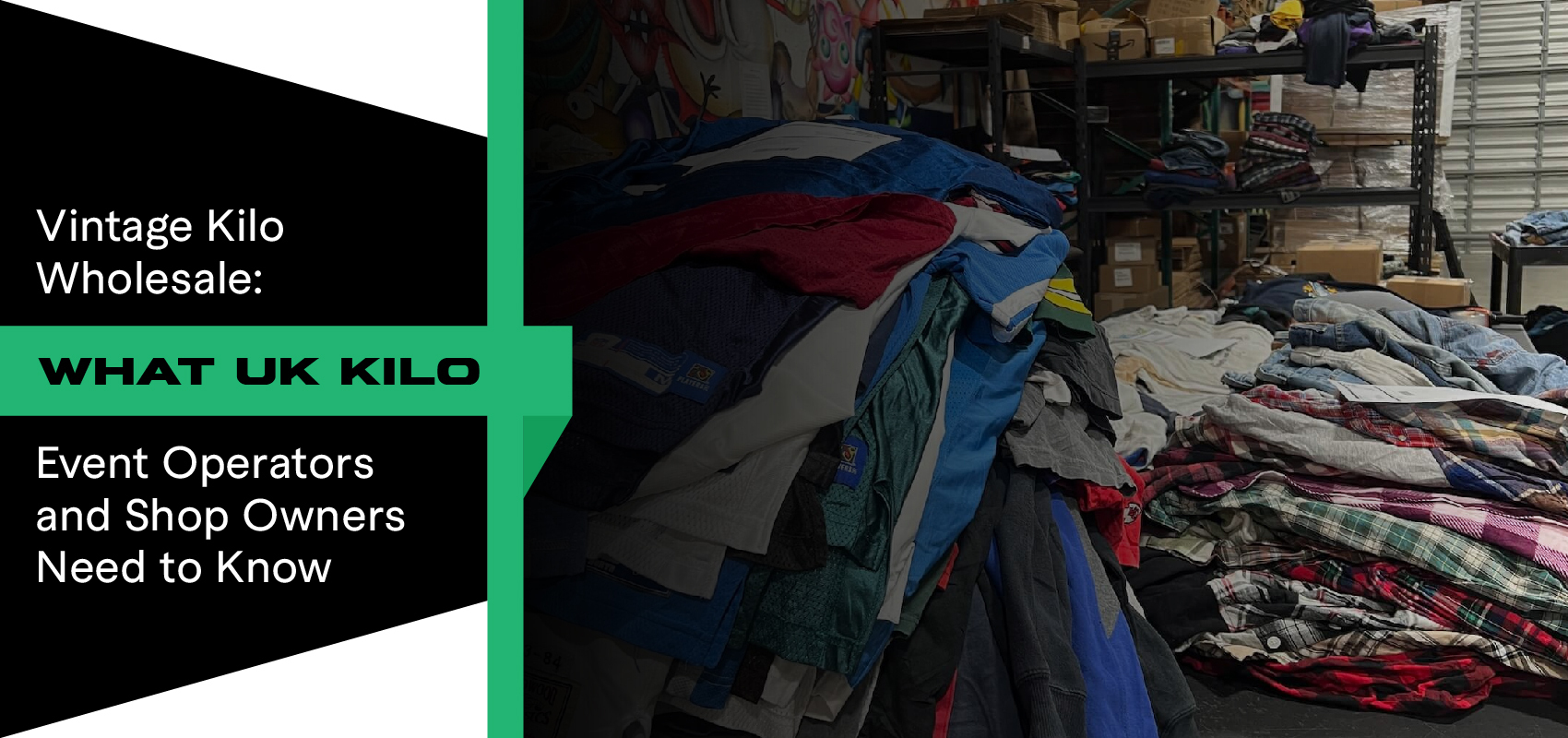
The kilo sale format has become one of the most recognisable parts of the UK vintage scene in recent years. Events sell out weeks in advance in London, Manchester, Edinburgh, and Bristol. Dedicated kilo shops have opened in city centres. Pop-up kilo fairs have built social media followings with attendees who queue before doors open.
Behind every successful kilo event is a wholesale sourcing operation that most customers never think about — the question of where hundreds or thousands of kilograms of genuinely sellable vintage stock actually comes from. This guide answers that question, covering what vintage kilo wholesale involves for UK operators, how the economics work, what categories perform best, and what a reliable supplier relationship actually looks like.
What Is Vintage Kilo Wholesale?
Vintage kilo wholesale means buying second-hand clothing in bulk by weight — and then selling that same stock to end customers at a flat per-kilogram price at an event or in a shop.
The margin in a kilo business is the gap between what you pay per kilogram wholesale and what your customers pay per kilogram at the event. If that gap is healthy and your yield is good — meaning most of what you bought wholesale is genuinely sellable — the business works. If the gap is thin, or the yield is poor, the margins disappear fast.
This is why wholesale sourcing is the central lever in any kilo operation. It’s not the most visible part of what you do, but it determines almost everything about whether the business is actually profitable.
How UK Kilo Operators Currently Source Their Stock
There are broadly three sourcing approaches in use across the UK kilo market, each with very different cost structures.
UK-based domestic wholesalers: are the most common starting point. These are businesses in the UK that buy from overseas exporters and resell to UK buyers in smaller quantities. The advantage is accessibility — no import process, payment in pounds, relatively fast availability. The disadvantage is cost. Domestic wholesalers add their own margin on top of what they pay for the goods, and that margin directly reduces what the kilo operator earns per kilogram at their event.
Charity shop and auction picking: works for very small operations and individual sellers, but it doesn’t scale. To run a regular kilo event with 500kg of genuinely varied sellable stock, you cannot sustainably source through charity shops. The volume simply isn’t there through retail channels.
Direct importing from overseas exporters: is how the most established UK kilo operators supply their events. Buying directly from exporters in countries like Pakistan means accessing stock at the source price — before any domestic wholesaler margin has been applied. The per-kilogram cost is lower, the category flexibility is better, and the relationship with the supplier means you can influence what you receive. The trade-off is managing freight and import documentation, which sounds intimidating the first time and becomes routine by the second or third container.
For operators running regular events or permanent kilo shops, direct importing becomes the more sensible option once monthly volumes reach a level where a 20ft container order makes financial sense.
What Vintage Stock Works Best at UK Kilo Events?
Not all wholesale vintage stock performs equally well when you’re selling per kilogram. The categories that create strong kilo event sell-through tend to have a few things in common: they’re varied, they’re immediately wearable, and they give customers the browsing experience they’re showing up for.
Variety is the foundation. A kilo event works because people spend time discovering things they weren’t looking for. A rail made up of similar items in a narrow category — say, 200 near-identical plain t-shirts — doesn’t create that experience. Customers browse, buy one or two pieces, and move on without fully engaging. Genuine variety across garment types, colours, and eras keeps people at the rail longer and spending more.
This is why mix vintage clothing wholesale is the foundation of most kilo operations. Good mix vintage covers multiple categories — tops, knitwear, trousers, jackets, outerwear, dresses — which gives event attendees real choice across a single price point. The treasure-hunt element that makes kilo events so popular with younger buyers only exists when the stock itself is varied enough to reward browsing.
Seasonal alignment matters more than operators expect. Selling heavy winter coats at a June event isn’t impossible, but it’s harder — customers at a summer kilo event aren’t mentally in outerwear mode. Most experienced operators align their buying calendar so summer vintage arrives for spring and early summer events, and winter vintage arrives for autumn. Getting this wrong means discounting items that should have been full margin, which is a direct hit to profitability. RK Exports supplies summer vintage and winter vintage as separate seasonal categories, so buyers can plan their buying schedule around their events rather than taking whatever arrives.
Y2K pieces are crowd-pullers. Including some genuinely interesting Y2K vintage clothing in your kilo rail creates a specific type of excitement that regular mix vintage alone doesn’t generate. Even at the same per-kilogram price as everything else, Y2K pieces are highly photographable, shareable on TikTok and Instagram, and attract the demographic that’s most enthusiastic about kilo events. Many operators include a deliberate proportion of Y2K-era pieces specifically because of the social media effect — customers who find and photograph a great Y2K piece at your event are, in practice, unpaid marketing.
Making the Per-Kilogram Economics Work
The numbers in kilo selling are worth thinking through clearly, because they look very different depending on your sourcing approach.
At small scale — 100 to 200kg per event — sourcing from a UK domestic wholesaler may be workable. The higher per-kilogram cost is painful but manageable when you’re still figuring out your format and customer base.
As events grow — 500kg, a tonne, multiple events per month — the per-kilogram sourcing cost becomes the dominant variable in your profitability. Here’s a simple way to see why:
At 500kg per event and two events per month, you’re moving roughly 1,000kg per month. If you’re paying £3/kg from a domestic supplier versus £2/kg from a direct exporter, that’s a £1,000 per month difference in sourcing cost alone. Over a year, that’s £12,000 — which is either margin, reinvestment capital, or the difference between a profitable and a marginal operation depending on how you look at it.
Direct importing also gives you control over what you receive that domestic buying doesn’t provide. When you order directly from an exporter, you can specify category proportions, request seasonal sorting, and ask for pre-shipment photos before the container ships. With a domestic wholesaler, you largely take what’s available.
The point at which direct importing makes clear sense is different for every business, but most kilo operators who make the switch find they don’t return to domestic sourcing once they’ve seen the per-kilogram difference.
What to Look for in a Wholesale Vintage Supplier for Kilo Events
Finding a wholesale supplier for a kilo operation is different from finding a boutique-level branded vintage supplier. The priorities are specific.
Volume capacity comes first. A supplier who can provide 200kg once in a while is not useful to a kilo operation that needs 500kg every few weeks. Before building a supplier relationship, confirm they can meet your ongoing volume needs consistently — not just as a one-off.
Consistency matters more than the lowest price. A bale at £2/kg that arrives with 30% unsaleable items produces worse economics than a bale at £2.50/kg with 95% sellable yield. For kilo operations where pricing is based on selling by weight, every kilogram of deadstock that doesn’t sell is a direct loss. Ask for pre-shipment photos, ask what the supplier’s rejection rate is at sorting stage, and start with a smaller test order before scaling volume.
Category variety within bales is a specific requirement. Ask any potential supplier to describe what a typical mix vintage bale contains in terms of garment type breakdown. A bale that’s heavily weighted toward one category — say, 70% t-shirts — limits your ability to create the varied rails that make a kilo event work. The best wholesale mix vintage for kilo events has genuine category breadth across tops, bottoms, outerwear, and knitwear.
Communication and reliability matter practically. If you have events booked and your container is delayed, you need a supplier who tells you proactively rather than leaving you to find out when it doesn’t arrive. The way a supplier handles problems before they happen — their response to questions, their transparency about lead times, their willingness to send pre-shipment verification — is a reliable indicator of how they’ll behave when something unexpected occurs.
Getting Started with Direct Importing for a Kilo Business
For UK kilo operators considering their first direct import, the process is more straightforward than it initially appears.
Start by clarifying what you need: total weight per order, category preferences, grade requirements, and how frequently you plan to order. Share this with a potential exporter and ask for a quote covering the goods cost (on FOB or CIF terms) plus enough information to calculate total landed cost including freight and import duties.
Find a UK freight forwarder or customs broker before the goods ship. They manage the import declaration, duty payment, and port clearance on your behalf, and they’ll tell you exactly what documents they need from the exporter. For a first container, this typically costs a few hundred pounds and is genuinely worth it.
Confirm fumigation certification before the container leaves the origin port. Used clothing imports require fumigation certificates, and missing or incomplete certificates are one of the most consistent causes of customs delays. Any experienced exporter handles this routinely — if a supplier is vague about fumigation, that’s a warning sign.
Once you’ve been through the process once, the second import is significantly simpler. Most kilo operators who move to direct importing describe the first container as the learning curve and everything after that as manageable admin.
FAQs
What is vintage kilo wholesale?
Vintage kilo wholesale refers to buying second-hand clothing in bulk at a per-kilogram wholesale price, to resell to end customers at a per-kilogram retail price at a kilo event or in a kilo shop. The margin between wholesale cost per kilogram and retail price per kilogram is the primary profit driver. Sourcing cost is therefore the single most important variable in whether a kilo operation is genuinely profitable.
How much do UK kilo event operators typically pay per kilogram wholesale?
Pricing varies depending on grade, category, and whether you’re sourcing through a UK domestic supplier or importing directly. General mix vintage through a UK wholesaler typically runs between £2.50 and £4 per kilogram. Sourcing direct from exporters in countries like Pakistan can reduce this meaningfully, particularly at container volume, which is why established kilo operations typically switch to direct importing once their monthly volume justifies it.
What types of vintage clothing perform best at UK kilo events?
Mix vintage with strong category variety consistently performs best — a genuine spread of tops, knitwear, jackets, trousers, and outerwear that gives event attendees real choice across the rail. Seasonal alignment (summer vintage at spring events, winter vintage at autumn events) improves sell-through rates. Including some Y2K pieces or interesting branded garments adds a browsing and social media element that extends time-on-rail for customers.
Is direct importing from Pakistan worth it for a UK kilo business?
For operators moving more than 400–500kg per month, direct importing almost always produces better per-kilogram economics than domestic sourcing. The sourcing cost saving across a year’s volume at that level is significant enough to represent the difference between a profitable and a marginal operation. The added complexity of managing freight and customs clearance becomes routine after the first container.
How do I verify the quality of wholesale vintage kilo stock before committing to a bulk order?
Request pre-shipment photos or video of open bales from the supplier before the container ships. Ask what percentage of garments are expected to be unsaleable at their grade level. Start with a smaller trial shipment before your first full container to verify condition and category variety against what was described. A supplier who is confident in their stock will accommodate all of these requests without hesitation.
Conclusion
Every successful kilo event or kilo shop in the UK is built on one thing before anything else: the quality of its wholesale sourcing. The variety and condition of what you buy, the per-kilogram cost you pay, and the reliability of your supplier determine your event atmosphere, your customers’ experience, your sell-through rate, and your actual margin. Operators who treat sourcing as the most important decision in their business — who take the time to find a supplier with real consistency, who plan their buying around their event calendar, and who understand the economics of direct importing — build kilo businesses that are genuinely sustainable. If you’re growing a kilo operation and still relying solely on domestic suppliers, the per-kilogram maths of direct importing is worth working through. The difference, at scale, is significant.